Mongolian Airlines Group

December 6, 2011 / Ulaanbaatar / ToMongolia

Though similar names, these are two different companies.
Mongoilan Airlines MIAT, and Mongolian Airlines Group.

Update May 2012
Mongolian Airlines Group (MR) will begin international operations from May 2012 through the summer, with service to China, Hong Kong and Japan
Mongolian Airlines Group website.

Ulaan Baatar – Tianjin  3 weekly flights. (postponed)
Ulaan Baatar – Erlianhot (Erenhot)  4 weekly (postponed)
Ulaan Baatar – Hong Kong from June 3 weekly
Ulaan Baatar – Tokyo Haneda from July, 3 weekly

Flights will be operated by the Airbus A319 aircraft.
= = =


A new Mongolian domestic airline will operate in 2012, adding competition to the two existing companies operating domestic flights.

The company "Mongolian Airlines Group LLC" was registered in 2011.
Antonov AN2 Mongolian Airlines mail service 1950's

The new registration of "Mongolian Airlines" is a revival of a similar company with the same name established in 1956 that flew the Antonov AN-2 aircraft at that time. The original "Mongolian Airlines" company has changed forms and ownership several times, involving separation from MIAT in 1992. Since September 2011, 100% of the airline stocks are owned by "Bodi Group" a Mongolian business conglomerate that reorganized the company.

Bodi Group includes 14 subsidiary companies, employing over fourteen hundred professionals. Bodi Group is actively engaged in rapidly growing fields of banking financing, property development, real estate, media, trade, aviation and services.

A first trial domestic flight of the newly registered company took off on November 18th 2011 as a charter flight to Bayankhongor.

In the past few years only two airlines, Eznis and Aero-Mongolia operated domestic flights.

The competition between the three companies has begun. Delgermaa Shagdarsuren who serves as Chief Commercial Officer at Mongolian Airlines Group LLC said that the company will offer special discounts. Today's launching charter flight to Choibalsan was sold for a special one time discount of only 100,000MNT".

Eznis has responded - "All Eznis one way flight tickets" will cost only 120,600MNT for a limited period of time to commemorate it's 5th year of operations.


In 2012 the airline will offer domestic flights using four aircrafts. The first Fokker-50 aircraft with it's new color scheme arrived in November 2011. The aircraft  will receive the registration number JU-8881, and it's c/n is 20183, built 21 years ago and used in the past by SAS. Other aircrafts in the fleet are two Airbus-A319 named Nirun and GreatMomgol, two Fokker-50 named Hunnu and Kidan, and  a Boing 737.


"Mongolian Airlines", Fokker 50, new color scheme painted at QAPS at Lelystad Airport in the Netherlands,
October 2011.  photo by Jeroen Schonewille, jeroen_92, on Flickr

The first Fokker-50 aircraft is named HUNNU (marked on the aircraft's nose) to commemorate the 2220th anniversary of the founding of the First State of Mongol – the Hunnu State.

Mongolian Airlines route map
The company will operate from Chinggis Khaan Mongolia's international airport, and operate domestic flights to Dalanzadgad in the South, Khovd in the West, Moron in the North, Choibalsan in the East, Bayankhongor and Arvayakheer in the center of Mongolia.

The "Mongolian Airlines" office is located in the Bodi group tower building  near Sukhbaatar Square, in the center of Ulaanbaatar  Tel: +976-11-310657. Fax: +976-11-310649.

Mongolian Airlines website was launched today www.mongolianairlines.com

See Mongolia Flights for complete information on Mongolian International and domestic flights.

By: Dan
Tomongolia@gmail.com

Mongolian Music

Contributing author:  Otgonkhishig  Bazarragchaa (Otgoo)

Mongolian music today blends east with west, modern with traditional, classical with rock and much more.

A perfect example of this wonderful blend is performed by the "Voice of Mongolia" group. They manage to fuse a rock band into an opera style of Mongolian songs.

The voice group website (in Mongolian)  www.voiceofmongolia.mn

The Moriin Khuur (horse head fiddle) is a traditional 2 string musical instrument popular amongst the Mongolian nomads. Today it is becoming a legitimate instrument playing a role in classical orchestras. A wonderful example is the Mongolian soloist Urtaa Gantulga playing a concerto for Morin Khuur and orchestra. Read and listen more about the Morin Khuur.

If you liked this piece, you may want to see part II and part III on Youtube.

The Motive band is becoming one of the leading Mongolian bands.
Motive has four members, all born in 1085. The band leader is Erdenebayar Boldbaatar,  Saintsogt Baasankhuu (Sainaa), Ankhbayar Erdenebat,  Ganbat Togtoh (Ganbaa). They graduated together from the Mongolian University of Culture and Arts. After graduation in 2007 they founded the Motive band.
The major breakthrough was in 2010 when they recorded their first album  Hairiin Gegee (Light of Love) and performed their first concert at the UB Palace. The album became immediately a big hit and remains in the top ten of album sales up to these days.
Their second album Tsan boroo (Snowy rain) followed by a great performance that took place in November 2011 at Bukhiin Urguu.
The band played a major role in the Mongolian movie  “Hairiin une tsene” (Value of Love) that came out in May 2011. The movie deals with Mongolian youth’s opinions,  love, relationships and violence. The band’s singer Saintsogt (Sainaa) had the lead role in the movie.
Love Music by Motive


Another famous Mongolian band is Altan Urag. Their musical style combines traditional Mongolian with contemporary influences. They played the sound trek of the Movie "Mongol". Altan Urag web site www.altanurag.mn/en.htm
Altan Urag


Further reading:
Mongolian music web site  mongolduu.com
Wiki on Mongolian music en.wikipedia.org/wiki/Mongolian_music
Blog on Mongolian music mongolianmusic.blogspot.com

Ulan Bator Naled Ice Shield

Yolin Am natural Naled ice shield

Artificial naled ice shield is a novel invention to combat global warming.

One of the most popular tourist attractions in Mongolia is the frozen ice in the Yolin Am canyon deep in the Gobi desert. The ice remains frozen throughout the hot Gobi summer.
These ice slabs are named by scientists Naled ice shields.

This unique natural phenomena has inspired a novel invention proposed by Robin a geologist residing in Mongolia. The idea is to create artificially such an ice slab near Ulan Bator during the freezing winter, and let it melt slowly during the hot summer. The ice will have an environmental impact on the micro climate around Ulan Bator, the same way it does in the Gobi desert.

The goal is to combat global warming with the help of mother nature. Ulan Bator is allegedly the coldest capital in the world. Temperatures drop down to -30 degrees Celsius during winter and rise up to +30 during summer. Harnessing the natural winter "freezer" to create a "natural" air conditioner for the city during summer.

The river Tuul runs alongside Ulan Bator. During winter the river freezes. In spring the ice breaks up.
To create a large ice slab that will remain throughout the summer, one has to imitate the way nature creates these naled ice shields in the Gobi desert..
The first to observe
He noticed that when a thin layer of water runs over ice and freezes during the night it creates a thin layer of ice. The next day another thin layer of water covers the ice and freezes. This creates a large slab of layers of ice which he named in Russion Naled. Robin in his research proposed to name it Naled Ice Shields.
Unlike rivers and lakes where freezing occures only on the top layer, while leaving the lower levels of water unfrozen, in a naled ice shield layers of frozen ice are created layer by layer bottom up, creating a solid frozen ice slab.


Following is an artist illustration of an artificial naled ice shield on the Tuul river near Ulan Bator. The rolling winds coming down the mountain will chill when passing by the naled ice shield and continue towards the city dropping the local summer temperatures by 2-3 degrees, similar to the breeze coming from the sea towards cities residing near a sea.

Ulan Bator artificial Naled ice shield (illustration)


text

text

Demchig Khiid

During the Soviet era in Mongolia the KGB destroyed over 900 temples and lamaseries in Mongolia between 1937 and 1939. Today, in one of the most dramatic signs of the recovery of religious and ethnic identity in the post-Soviet “transition” period, Mongolian cultural leaders are seeking to document and reconstruct these priceless Buddhist structures and culture.

Within the Khanbogd "Circle" there are several significant ruins. "Ivanhoe" mining corporation has recently contributed to the reconstruction of the Demchig Hiid Monastery.


Demchig Hiid Monastery
as seen from space


Recent reconstructions of the Lotus shape structure
at Demchig Hiid

Tsagaan Tolgoi

remains in the sand, of what seems to be a temple
at Tsagaan Tolgoi

MonGoogle Atlas

THE MonGoogle ATLAS


General map 
Mongolia and it's neighboring countries


FLIGHTS
Flights International
all flight routs to and from Mongolia


Flights
Flights International - all routes to and from Mongolia.
Flights Domestic - all internal routes and local airports.
Trains
Train International - all rail routes to from and through Mongolia.
Train Domestic - all internal routes and local train stations.
Buses
Bus Routes Ulaanbaatar - all bus routes in the capital city Ulaanbaatar (Ulan Bator).
Bus Routes Countryside - all bus routes to the Mongolian countryside.
Petrol
Petrol Stations - all the petrol stations including some hard to find in remote locations.
Attractions
Monasteries - all Mongolian monasteries in Ulaanbaatar and throughout the country
Activities
Horse riding - all the best horse riding regions and ranches.
Fishing - all the best fishing spots on Mongolian lakes and rivers
Cycling - all the main cycling routes across the country for cross country cycling
Motorbike - all the main motorbike routes for cross country riding
Borders
Border crossing - all the border crossings and entry points for tourists.
Petrol stations - all the petrol stations including some hard to find in remote locations
Trek

    Gazelle

    gazelle enhanced

    Mongolian Gazelle (BBC Planet Earth)

    end bbc

    video


    gazelle end
    map
     add china Russia to map add editor: tomongolia  check 1995?
    photo

    Border Crossings


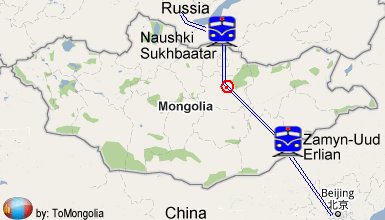
    The majority of tourists enter Mongolia through three entry points. By flight to the capital Ulaanbaatar (Ulan Bator). By train or car from China (Zamin-Uud border crossing). By train or car from Russia (Sukhbaatar/Altanbulag).


    See the detailed Google map of all the border crossings, with data on each crossing. Zoom in and click the icons to see details.


    Following is a description of - flight, train, road and trade border crossings.

    Flight

    All International flights land at Chinggis Khaan airport in Ulaanbaatar, with one exception - flights from Kazakhstan land in Olgii in west Mongolia, tourists are permitted to enter Mongolia through Olgii, with this flight.

    A flight from Hailar in China does have a stop over in Choibalsan in east Mongolia, before reaching Ulaanbaatar, but tourists are not permitted to get off at Choibalsan.

    For more see the Flights page - all airlines and all flight options into Mongolia.

    Train
    The trans Mongolian train connects Russia and China through Mongolia. A few trains a week reach Ulaanbaatar from both countries.

    For more see the TransMongolian train page for detailed train options.

    Road


    The Zamyn-Uud/Erlian from China and Altanbulag/Kyakhta from Russia, have full services for tourists. The others have limited services. The main issue is limited options for transportation to, from and across the border. You may use one of these, if you enter with your own car, bike, or pre-arrange for someone to meet you and take you across and beyond the border crossing. Crossing by foot is prohibited.

    Opening hours
    The general rule is that border ports are open weekdays 10:00-17:00
    some are open 24h, and some open on weekends too.
    All road border crossings are closed on national holidays.
    (Train and flights operate all year round).
    Dates of closed borders: New year January 1st, three days of the Chinese lunar new year (annually occurs on different days of the month).  May 01-03, October 01-03, two days of the Mongolian lunar new year (annually occurs on different days of the month). March 08, June 01, July 11-12, and November 26 annually.


    Trade

    Tourists can not enter through any of these crossings. They are used for trade mines export, and for locals with Chinese or Russian passports.
    In addition to these there are several temporary border crossings used by local herders. For complete details see the Google map.


    Official border schedule (in Mongolian)


    Naadam 2011


    This is last year program. - 
    Go to Naadam 2012 program

    Naadam 2011
    Naadam festival, (11-13 July 2011), is the happiest time in Mongolia. It is also the peak of the tourist season. In Mongolian Naadam is known as "eriin gurvan naadam" (эрийн гурван наадам), meaning - the 3 games of men. The 3 games are horse racing, archery and Mongolian wrestling. Some call it the Nomadic Olympic Games. These games have existed for centuries, and incorporate warrior skills.

    The festival is performed throughout the country. The central ceremonies and competitions are held in Ulaanbaatar.
    This year (2011) In UB there will be 512 wrestlers competing in 10 rounds, 420 out of them hold a state title. 3,500 horses in six age categories will be dashing across the Khui Doloon Khudag fields.

    UB Locations
    The festival events will take place in several locations;
    Sukhbaatar Square - parades, concert and ceremonies (City centre)
    Khui Doloon Khudag - horse racing, (west of Ulaanbaatar on the main road leading to Lun see map)
    Central Stadium - opening, closing ceremonies, and wrestling.
    Archery stadium - archery
    Anklebone tent - anklebone shooting
    Central Cultural Palace - concert in celebration of the National Naadam Festival

    Cost
    Tourists can buy daily tickets for USD25 from the Metropolitan Tourism Department, or through hotels and tour operators.


    Countryside Naadam Events  
    (Check with your local tour guide before going, dates might change)
    Naadam events will take place  in all Aimags (provinces). Each Aimag decides on the festival dates, they are spread out over three dates in July, 11-13, 22-23, and 29-30.  (source:  www.vip76.mn).
    Popular tourist destinations arrange Naadam festivals oriented towards tourists; Khatgal south of Khovsgol lake 11-12 July,
    Olgii 17-19 July,
    Darkhad valey 25 July,
    Terelj park 12 and 21 August 2011.

    Aimag  Naadam festivals for 1-2 days
    during 06-13 July 2011, (check locally exact date)
    6-7 sukhbaatar
    8-9  Bulgan, Govi-Altai, Orkhon, 
    10-11 Arkhangai, tuv, khentii
    11-12 Ulaanbaatar 
    Bayan-Olgii uncertain. 
    Zavkhan already celebrated


    Aimag  Naadam festivals during 22-23 July 2011  
    Aimag - (Capital) - Distance from UB
    Khovsgol, (Moron) 780km
    Dundgovi, (Mandalgovi) 280km
    Selenge, (Sukhbaatar) 320 (train)
    Darkhan-Uul, (Darkhan) 220 (train)
    Omnogovi, (Dalanzadgad) 580km (not 29-30)

     
    Aimag  Naadam festivals during 29-30 July 2011 
    Aimag - (Capital) - Distance from UB 
    Govisumber, (Choir) 240km (train)
    Dornod, (choibalsan) 660km
    Dornogovi, (Sainshand) 450km (train)
    Khovd, (Khovd) 1490km

    Ovorkhangai, (Arvaikheer) 430km
    Bayankhongor, (Bayankhongor) 640km
    Uvs, (Ulaangom) 1400km

    National Anniversaries
    The Naadam celebrations in 2011 commemorates the various anniversaries of the Mongolian state through history.

    Celebrating the 2220th anniversary of the Hun Empire
    The establishment of the Hun state (Xiongnu, Хүн улс) by Toumen in the 3rd century BCE marks the beginning of statehood on the territory of Mongolia.  His son Modu Shanyu conquered and unified various tribes. At the peak of its power, the Hun confederacy stretched from Lake Baikal in the north (Russia today) to the Great Wall of China in the south.


    Genghis Khan
    Celebrating the 805th anniversary of the Great Mongol Empire 
    The Mongol Empire was founded by Genghis Khan in 1206. At the peak of its power, the Mongol empire stretched from the ocean all the way to Europe.


    Celebrating the 100th anniversary of National Freedom
    During the collapse of the Qing (Chinese) Dynasty  in 1911, Mongolia declared independence.  Bogd Gegeen was enthroned as Bogd Khaan (Great Khan, or Emperor) of Mongolia on 29 December 1911.


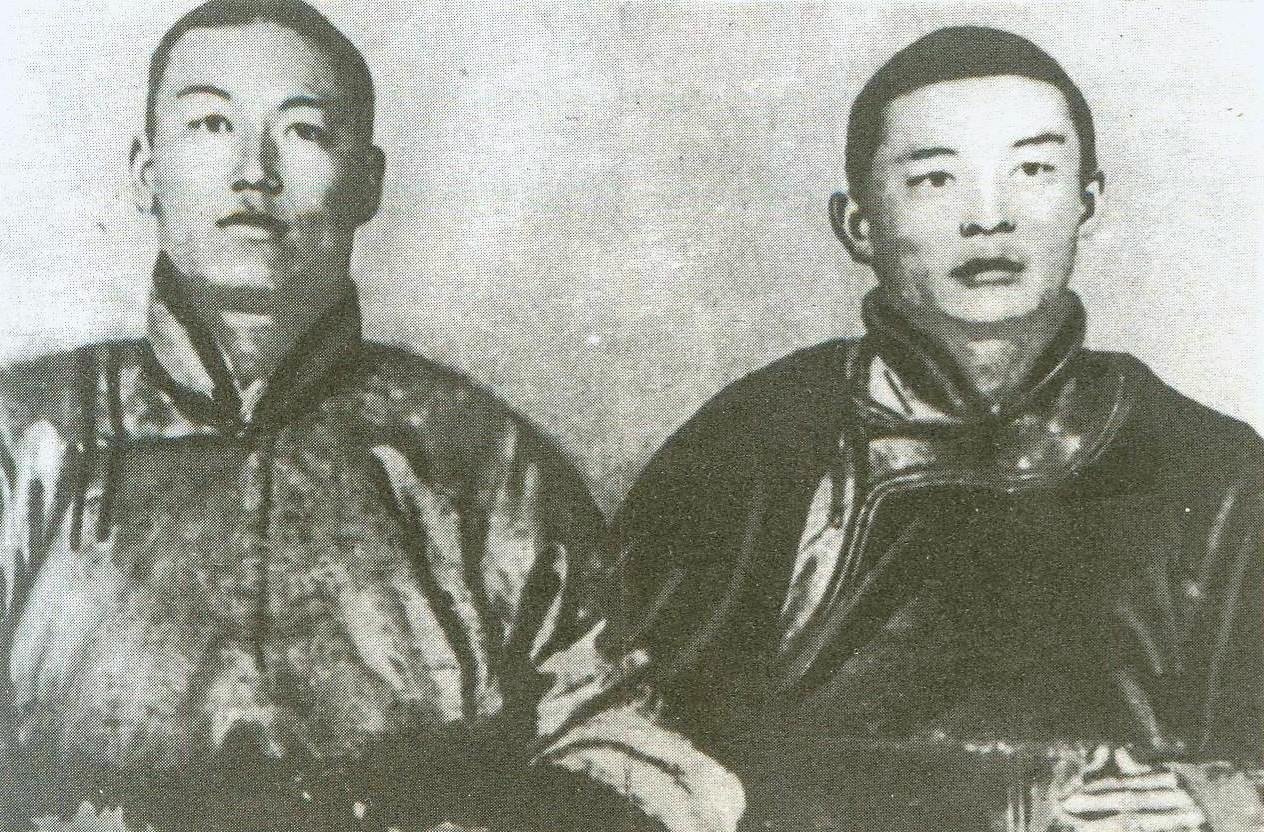
    Celebrating the 90th anniversary of the People's Revolution
    Sukhbaatar and Choibalsan,
    revolution leaders.
    Under strong Soviet influence, the Mongolian People's Republic was declared in 1921. The revolution against the Chinese began on the 18th of March when 400 volunteer troops led by Sukhbaatar attacked the 2000 Chinese garrison in Kyakhta at the northern frontier of Mongolia. The Mongolian People's Party troops and Russian Red Army troops entered Urga (Ulaanbaatar of today) in July 1921.

    Celebrating 21 years of democracy
    After the breakdown of communist regimes in Eastern Europe in late 1989, Mongolia began its own democratic revolution in early 1990, which led to a multi-party system, a new constitution in 1992, and a transition to a market economy.


    Detailed 2011 Naadam program in Ulan Bator

    July 11                                                                                                         
    8 a.m. – 10.40.a.m.       Over 5 years old horse racing in Hui Doloon Hudag
    10 a.m.                         Semi-final of ankle bone shooting in tent of archery
    11 a.m.                         Ceremony of nine white banners in central stadium 
    11.10 a.m.                    President of Mongolia, opens the  Naadam
    11.20 a.m.                    Opening ceremony of Naadam Festival 
    11.30 a.m.                    Opening of ankle bone shooting in tent of ankle bone
    12.10 a.m. - 4.30 p.m.  First round of wrestling
    1 p.m -1.30 p.m.           United showing shooting of archery in field of archery
    1.30 p.m. – 4 p.m.         First round of children wrestling
    2  p.m. – 4.40 p.m.        Over 5 years old horse racing  in Hui Doloon Hudag
    2 p.m.                            Semi-final of ankle bone shooting in tent of ankle bone
    2 p.m.- 5 p.m.                National archery in field of archery
    4.20 p.m. – 6 p.m.          Second round of children wrestling
    4.40 -8.20 p.m.              Second round of wrestling
    7 p.m- 11 p.m.               “Ulaanbaatar night” concert 

    July 12
    7 a.m. – 10 a.m.               4 years old horse racing in Hui Doloon Hudag
    9 a.m.                              Ankle bone shooting final in the tent of ankle bone
    9 a.m. – 2 p.m.                Semi-final of archery in field of archery
    9 a.m. – 11.30 a.m.         3rd round of wrestling
    9 a.m. - 10.30. a.m.        3rd round of children’s wrestling
    10.50 a.m. - 12.10 a.m.  4th round of children wrestling
    11 a.m. -1 p.m.               One year old horse racing in hui doloon hudag
    11.40 a.m. -1.30 p.m.      4th round of wrestling 
    2 p.m.                              Ceremony of awarding to  ankle bone shooting winners 2.10 p.m. - 2.30 p.m.       United showing shooting of archery in central stadium 
    2 p.m. – 3.30 p.m.            5th round of wrestling
    3.30 p.m. – 4p.m.             5th round of children wrestling
    3.30 p.m.                         Ceremony of awarding to horse racing winners in five
    3.30 p.m. – 4p.m.            5th round of wrestling
    3.50 p.m.                         President of Mongolia, will give child jockeys a present
    3.50 p.m. – 5 p.m.           6th round of wrestling
    5 p.m.- 5.10 p.m.            President of Mongolia, will award archery winners
    4 p.m. – 4.40 p.m.           6th round of children wrestling
    5.20 p.m. – 6.10 p.m.      7th round of wrestling
    6 p.m. – 6.30 p.m.           7th round of children wrestling
    6.10 p.m. – 6.20 p.m.      President of Mongolia, will award wrestlers  5/6 rounds
    6.20 p.m. – 6.50 p.m.      8th round of wrestling
    7.10 p.m. – 7.30 p.m.      9th round of wrestling 
    7.30 p.m.- 7.40 p.m.       President of Mongolia, will award wrestlers  7/8 rounds 7.50 p.m. – 8.20 p.m.     10th round of wrestling
    8.40 p.m. – 8.55 p.m.      President of Mongolia, will award champion wrestlers
    8.55 p.m. – 9 p.m.           President of Mongolia, will close the Naadam festival
    9 p.m.                              Closing ceremony and ceremony of nine white banners

    Additional activities
    July 5th-9th 2011 Mongolian Cultural Days – 1p.m.-5p.m. in Sukhbaatar square
    (5.7 ger day, 6.7 dairy products, 7.7 ancient script, 8.7 folk music 9.7 costume)
    July 10th army parade (2,000 soldiers) at Sukhbaatar square.
    July 13th costume festival  in Sukhbaatar square 12:00-8:00pm

    (Previous years programs 2010 program and 2009 program)


    The Bulgan Border Crossing


    News for tourists - (originally posted on May 2011)

    The Bulgan/Takashiken border crossing  in West Mongolia/China is now open for all passport holders and operates all year round. New options are now available for tourists to combine tours in west China and west Mongolia.

    Takashiken/China border crossing administration building
    According to Erdenechimeg, International Cooperation officer, at the Office of Customs General Administration of Mongolia -
    "The border between Mongolia/Bulgan/ and China/Takashiken/ is an international port open for third party. It operates all year round, and open Monday to Friday 9 am to 6 pm."


    Location and distances
    Takashiken (China) is located in the western part of China in the Qinghe County in Xinjiang province. The province capital Urumqi,  is 510km from the border.
    Bulgan (Mongolia) is located in the western part of Mongolia in the Khovd province. The province capital Khovd, is 265km  from the border.

    Getting there
    If you are limited with time, hire a jeep. For budget travelers with plenty of time you can use a non-scheduled public transportation.   
    There are mini buses from Olgii to Khuvd. From Khuved find vans to Bulgan or even to the border. They do not have a scheduled time table. They fill up and go, it might take a day or two to fill up.
    A shared jeep from Bulgan to the border is 10,000-15,000 per person. 
    There is a bus crossing the border when there are people going through. On the Chinese side there are buses between Urumqi and Takashiken. They do not operate all year.
    In China the bus from Urumqi to Takashiken is a 12 hour ride and costs about 250 Yuan. 

    Map

    View Qinghe (China) / Bulgan (Mongolia) Border Crossing in a larger map


    Mongolia to China - Regulations
    From Mongolia to China - The Mongolians will make sure one has a valid Chinese visa.
    Walking Through or cycling is possible. A bus at Takashiken is available for going to Urumqi.   
    If you cross with your own vehicle in accordance with the Chinese regulation one should show evidence of a registered Chinese guide waiting on the Chinese side,  this rule is only enforced on tourists crossing into China with their own vehicle.


    China to Mongolia - Regulations
    From China to Mongolia - to get to the Chinese side of the border you can get by bus from Urumqi. If you hitch-hiking you should attain a Chinese border region permit.(see the road sign below).
    You will have to show a valid Mongolian visa.
    If your passport demands a visa, there is no way of obtaining a visa at the border.

      
    A Chinese road sign on the way to the Takashiken border
     
    Transportation across the border
    You can walk through or use the shared vehicle.


    Driving your own vehicle or riding your bike across the border is permitted, and recently tourists have walked across with no problem.
    If you have limited time it is advised to pre-arrange a pickup on each side of the border.


    Operating Hours
    The main purpose of this border crossing is for commercial and mining trucks use. Therefore it operates during work days - open from Monday to Friday from 9:00 to 18:00.  Note that the border is closed on Saturday, Sunday and national holidays.

    Chinese tour operators
    To cross from Mongolia to China you may want to make arrangements with a Chinese tour operator. Following are a few which operate in west China.
    Qinghe Kanas International Travel Service Ltd.
    Xinjiang Overseas International Travel Service.
    Spring from Desert Roses desert_roses@sina.com  +86 135 7981 0241

    History of the Bulgan/Takashiken border
    Historically the Bulgan/Takashiken border crossing served traders transporting goods between west China and west Mongolia.

    During the Yuan dynasty founded by Kublai Khan the grandson of Genghis Khan   (13th century AD) this route became an important link to the famous silk road. Trade caravans of silk, tea and other merchandise crossed between East and West on the way to Europe. Up to the 1960's traders exchanged livestock and  agricultural commodities across this border. 

    The trade between China and Mongolia deteriorated under the Soviet influence over Mongolia. After the collapse of the Soviet Union, Mongolia became independent from the Soviet (Russian) influence. In July 1989 the border opened  occasionally. Following negotiations between China and Mongolia the border opened for longer periods to facilitate increasing trade and family visits of Kazakhs living on both sides of the border.

    Because of its undeveloped infrastructure and remoteness, the border was opened only for two weeks during each of the Summer months. Aside from a few exceptions, the border served only Mongolian and Chinese citizens.

    Mongolia is rich in iron and coal ores which are in high demand in China. In 2008 , Mongolia Energy Co., Ltd. decided to invest 20 billion yuan to pave the 360km international road crossings, across the Bulgan/Takashiken border.

    In 2009,  Xinjiang Kai Yu Mining Co., Ltd. invested in building a large logistics center in Takashiken including a new minerals customs warehouse, and purchased large trucks to transport coal and iron to China.

    With the increase volume of trade and in anticipation of increased tourism the border facilities were upgraded recently to international standards on both sides of the border. Following a mutual resolution signed on October 14, 2010, the border is now (2011) an international border serving all passport holders, and open all year round.
    .
    Satellite image of the border crossing

    View Qinghe (China) / Bulgan (Mongolia) Border Crossing in a larger map

    source: http://www.hudong.com/wiki/%E5%A1%94%E5%85%8B%E4%BB%80%E8%82%AF%E5%8F%A3%E5%B2%B8 
    for updates see Lonely Planet forum

    Fishing

    When

    Fish

    where

    Law

    Video


    end